
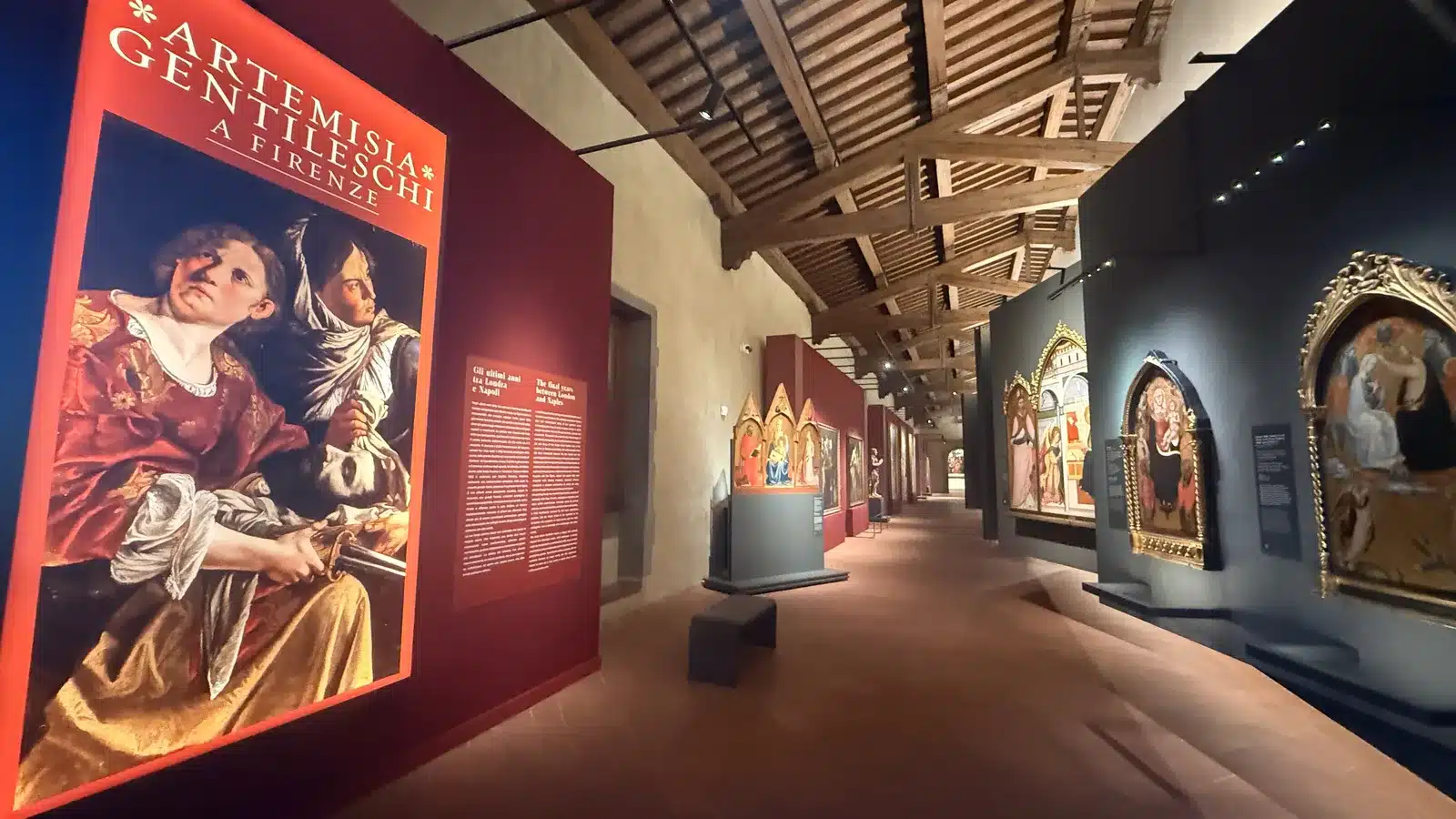
At the Museo degli Innocenti, more than 50 works tell the story of how a young painter from Rome became a professional at the Medici court, until 4 April 2027.
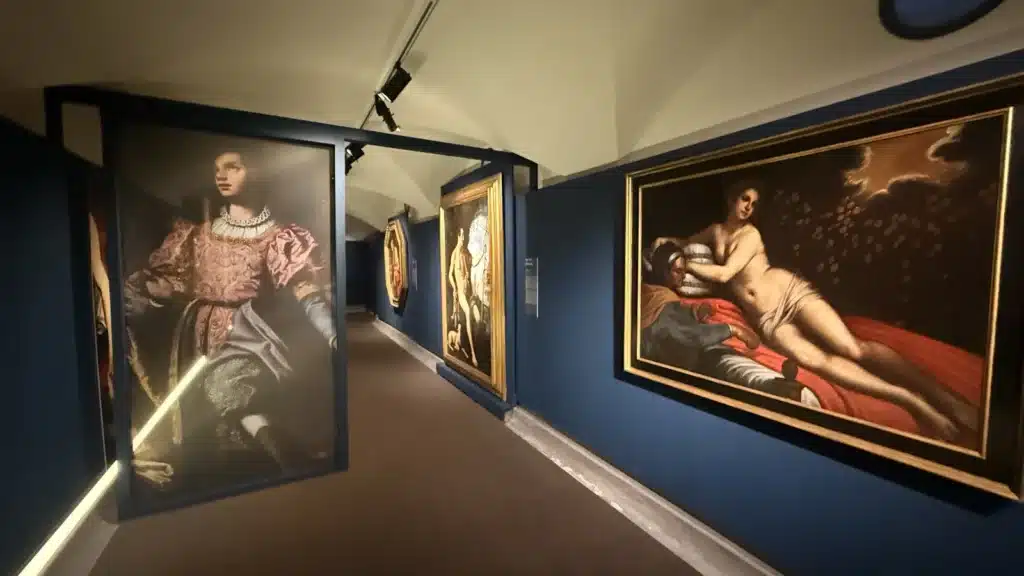
Artemisia Gentileschi (1593-c. 1656) has become, in recent decades, shorthand for the avenging woman, the feminist icon, the heroine of a hundred rebooted stories. The Museo degli Innocenti’s new exhibit, open through 4 April 2027, asks us to meet the painter on her terms, making its case in the rooms themselves, hung in red damask and lettered in gold.
Artemisia’s work appears alongside a curated collection of paintings by other leading figures in 17th-century Florence, including Cristofano Allori, Francesco Furini, Cesare Dandini, Giovanni Martinelli, Filippo Tarchiani, Ottavio Vannini, Lorenzo Lippi, Il Volterrano, and Jacopo Vignali, offering insight into a dynamic era in which different artistic traditions influenced one another.
The exhibit brings together paintings held throughout the world. Some are rarely seen by the public, or have been loaned on an exceptional basis for this exhibit. Loaning institutions include the Vatican Museums, the Uffizi Galleries and Palazzo Pitti, the Capodimonte Museum, the Houghton Hall Collection, Palazzo Madama, Civic Museum of Ancient Art in Turin, the Casa Buonarroti Foundation, the National Gallery of Umbria, the National Art Gallery of Bologna, and the National Gallery of the Marche, among others.
The engaging exhibit is accompanied by short films and classical music and appeals to both amateurs and aficionados. Dozens of works take us through her accomplished career, showing an artist whose talent clearly outgrew the limits her culture set for her. And for the first time, as the museum states, an exhibit focuses on the Florentine period of Gentileschi’s career.
Rome, 1593-1612
Artemisia was born in Rome on 8 July 1593, the only daughter of the painter Orazio Gentileschi. Her father, a close friend of Caravaggio, publicly recalled how the great artist dropped by the house to borrow some angel wings. We might imagine that her childhood smelled of turpentine and wooden cupboards, and echoed with arguments about composition and light.
She received a rare education. Women were barred from the academies, so she trained in the family workshop among working professionals and masters. From the start she painted cloth: the weight of a sleeve, the shine of silk, how drapery announces a fortune. Looking deeper, she found the motivations and fears in the faces of her subjects. She was a prodigy. Susanna and the Elders is dated 1610, when she was just seventeen.
Then an event occurred that features prominently in every biography of Artemisia Gentileschi. Orazio hired a colleague, Agostino Tassi, to tutor his daughter. Instead Tassi raped her. Her father took Tassi to court, and the trial in 1612 lasted seven months. The record reflects that the court had her tortured to confirm her testimony. Tassi was found guilty and sentenced to banishment from Rome, but the punishment was never enforced.
Artemisia left Rome soon after the trial. In Florence she was free of the unhealthy public attention that drove her from Rome, and she found a milieu that not only recognized but nurtured her talent.
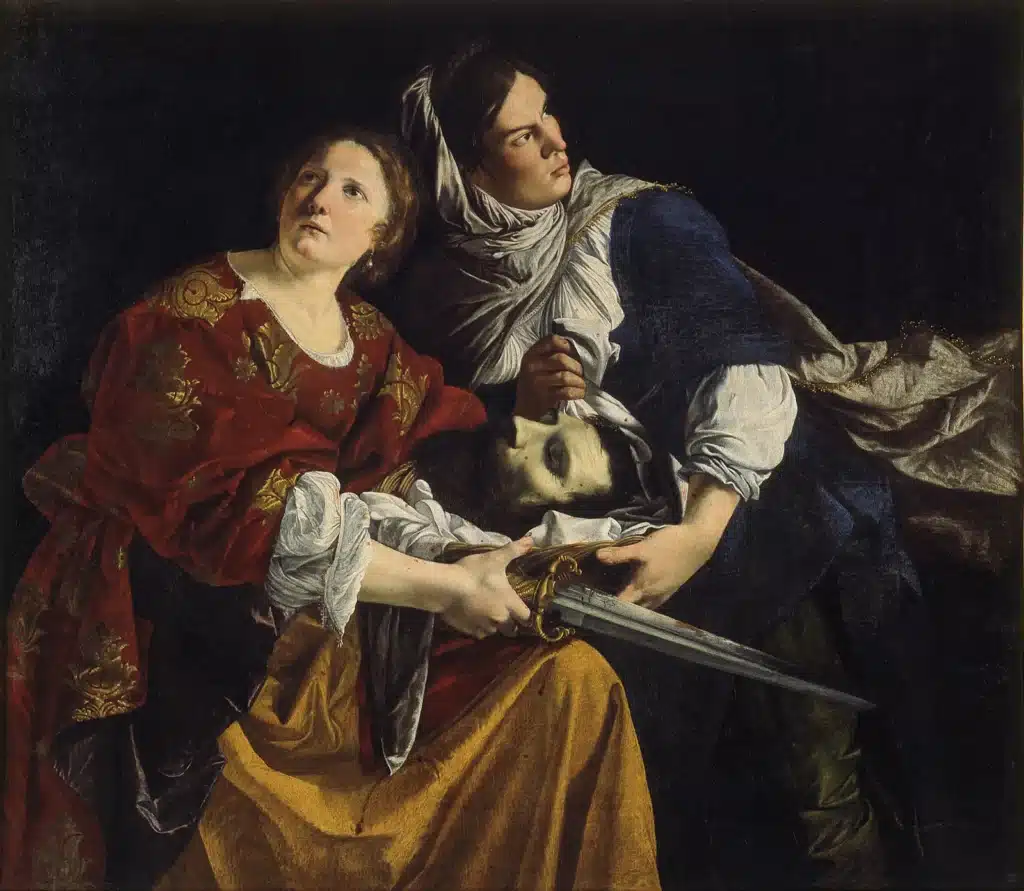
Giuditta e l’ancella con la testa di Oloferne 1622 circa
Città del Vaticano, Musei Vaticani
Florence, 1613-1620
Two days after the verdict, she married a Florentine painter of modest means, Pierantonio Stiattesi, and the couple relocated to Florence, an energetic cultural center led by the court of Cosimo II de’ Medici, the Grand Duchess Mother Christina of Lorraine, and Maria Magdalena of Austria, Grand Duchess Consort of Tuscany.
In Florence Artemisia reached artistic maturity, becoming one of the first women admitted to the Accademia delle Arti del Disegno in 1616, winning prestigious commissions from the Medici, and moving among the leading artists of the day, Galileo among them. One of her first major commissions came from the Casa Buonarroti, Michelangelo’s house, which his great-nephew was transforming into a monument to the master. Gentileschi was the only woman invited to participate in this project.
You will find the spirit of Caesar in the soul of a woman!
Artemisia Gentileschi to Don Antonio Ruffo, 1649
Her best-known picture is the Uffizi Judith Slaying Holofernes (1620), in which two women hold down a man and slice his head off. No one in the picture hesitates. In the quieter Judith and Her Maidservant, which Artemisia painted in several versions, one of them on show here, the women look off to the right, as though someone has called them, while the severed head sits in a basket. The violence has concluded but the danger continues. It is a painting about the pause after violence.
Across the same years she painted herself into other women’s stories. Her Self Portrait as Saint Catherine of Alexandria, painted in Florence about 1615-17, deliberately gives the martyr her own features and depicts a resolve that has survived torture. The effect is unsettling. We gaze upon the painter herself, a woman insisting on an inner life in a culture that did not expect her to have one. The Allegory of Inclination (1615-1616) depicts the vocation that leads to destiny.
In painting after painting the women are embodied: weighty and warm in the manner of classical art, as though to lift them above the ordinary world. The men, by contrast, function as accessories. They arrive wearing the uniform or costume of a role, say a soldier or a duke. Artemisia reverses a habit of centuries: here, women are bodies and men are uniforms.
Her household grew as the career did. She and her husband had several children in Florence. A professional woman with a young family and a husband, she kept working and painting.
In Jael and Sisera (1620), a woman drives a tent peg through the head of a sleeping general. The scene metaphorically mirrors Artemisia responding with strength in a man’s world.
She will finish the paintings and satisfy everyone, and then she will do as much as God wills.
Pierantonio Stiattesi to Francesco Maria Maringhi, Rome, 2 March 1620
Away and back again, 1620-1656
In 1620 she returned to Rome for about six years, and her career took her through Venice. In 1630 she moved to Naples, where she worked alongside established painters. Naples was then the largest city in Italy and part of the Spanish empire, and her Annunciation is her first known altarpiece commission, probably painted soon after she arrived. Unlike other outsiders, who met hostility from the local painters, she seems to have been accepted into the city’s cultural life.
In 1638 she joined her father at the court of Charles I in London, where she assisted him with a ceiling allegory at the Queen’s House in Greenwich. Yet the reunion was short: Orazio died in 1639. Artemisia returned to Naples, where she seems to have stayed for the rest of her life.
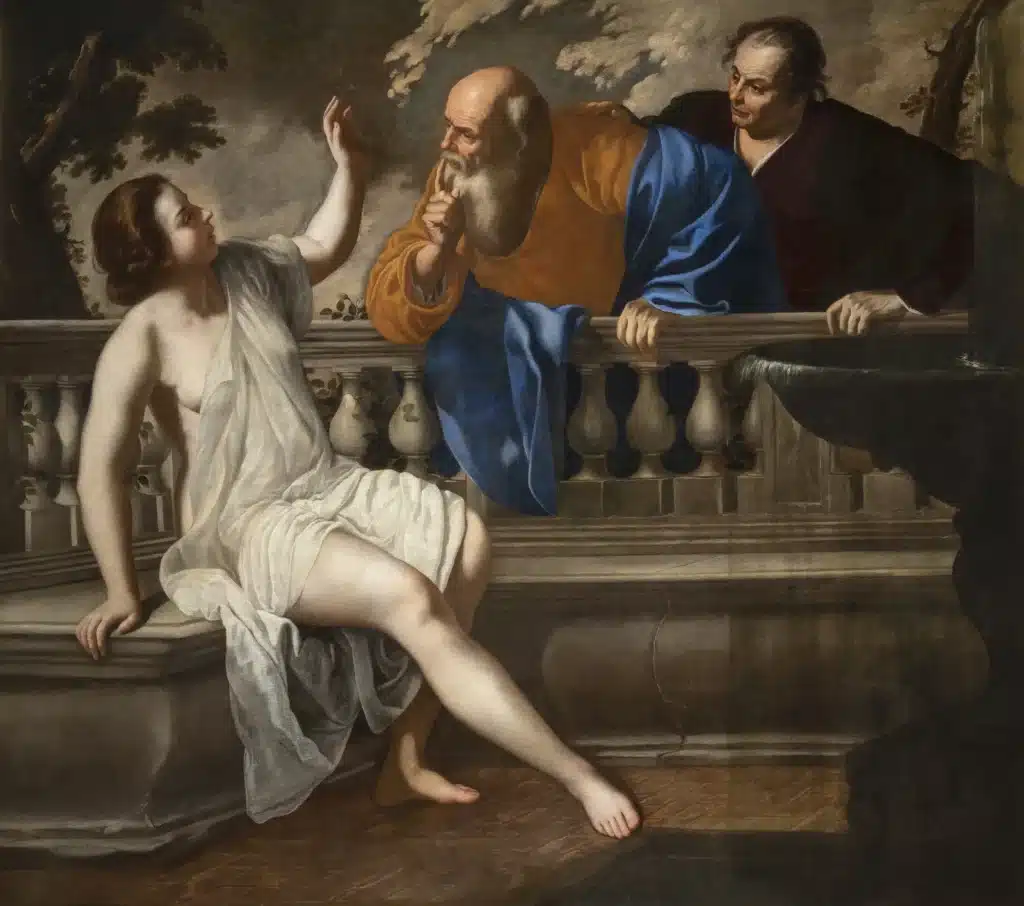
Susanna e i vecchioni 1652
Bologna, Pinacoteca Nazionale, Polo Museale dell’Emilia Romagna
Crediti fotografici: Su concessione del Ministero della Cultura – Archivio Fotografico dei Musei Nazionali di Bologna – Direzione regionale Musei Nazionali Emilia Romagna
The daughter and the end
She trained her only surviving child Prudenzia, who may also have worked as a painter in the Naples workshop. Historians once placed Artemisia’s death in 1652 or 1653, but evidence of commissions as late as 1654, and the Naples plague, have led many to believe she died in 1656. If so, her career ran from adolescence into her early sixties, decades in which she kept finding patrons across half of Italy and England.
The verdict
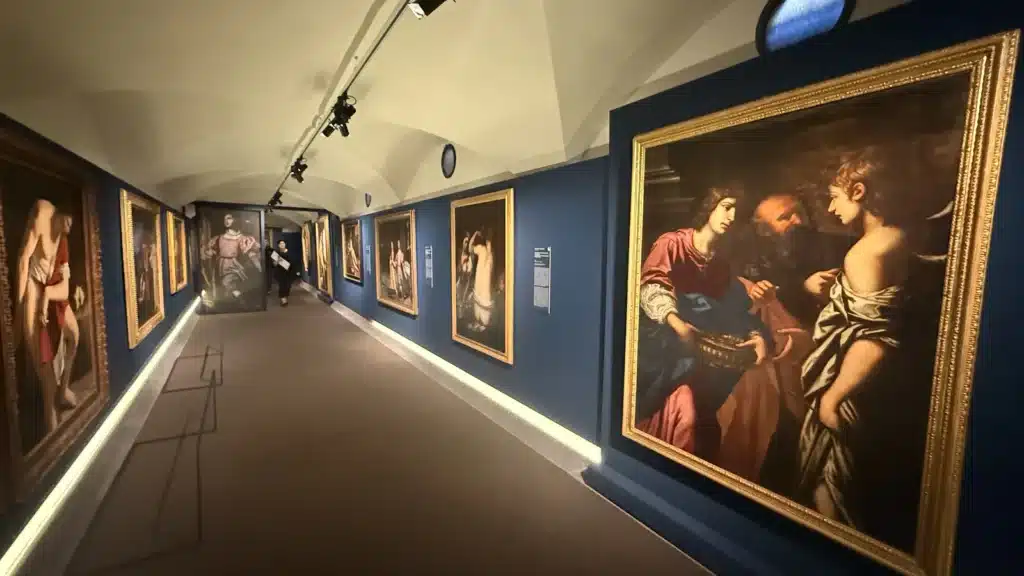
The popular Artemisia is cast as a revenge story. The Innocenti’s Artemisia is a working professional, with patrons, a guild, a studio and a family to feed, who painted the strongest women in Baroque art because she believed in women’s strength. That Artemisia is more interesting, and far harder to reduce to a slogan. Go for the paintings, and lose yourself in the rooms and classical music. Don’t miss the enormous canvases on the upper floor, which share the building with the Innocenti’s permanent collection, also well worth your time.
How to visit
Artemisia Gentileschi a Firenze runs through 4 April 2027 at the Museo degli Innocenti (Piazza della Santissima Annunziata 13), daily from 9:30 to 19:00, with last entry an hour before closing. Booking ahead is strongly recommended; a full ticket is €16 (open-date tickets €19, ticket.it only) and also covers the permanent collection. Holiday hours vary, so check the museum’s site before you go.